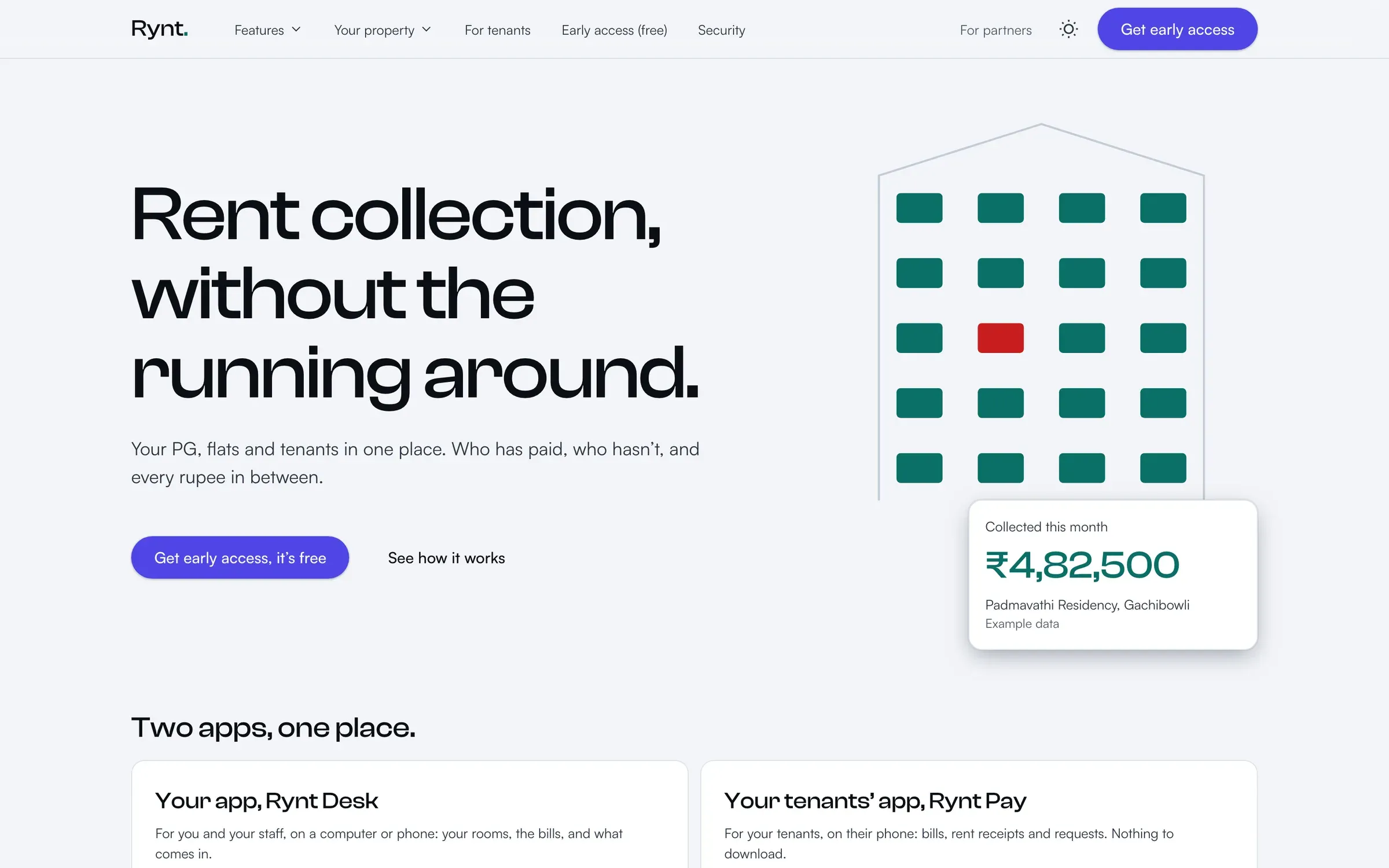
Rynt helps owners of PGs, hostels and rented flats in India keep track of rent, cash, deposits and receipts in one place. TrioFlare designed and built the whole platform: the owner portal, the tenant portal, the admin console and the ryntpay.com website.
Select a screenshot to see it at full size.
About Rynt
Rynt is for people who rent out homes in India: a single flat, a whole building, a PG or hostel rented by the bed, or flats in a gated community. Most of these owners run the month from a notebook, an Excel sheet and a long list of WhatsApp chats. Rynt puts the buildings, the tenants, the monthly bills, the cash and the deposits in one place, so the owner can see who has paid and who hasn’t.
TrioFlare built the whole product, from the database to the screens and the public website.
One platform, three portals
Everyone uses the same sign-in page and lands in the portal meant for them.
- Owner portal: for owners and their staff. Properties floor by floor, tenants, monthly bills, payments, deposits and receipts.
- Tenant portal: for tenants, on their phone. What they owe, every bill in detail, rent receipts to download and the deposit their owner holds.
- Admin console: for the Rynt team. Approving new owners, looking after each owner’s account and keeping a record of every action.
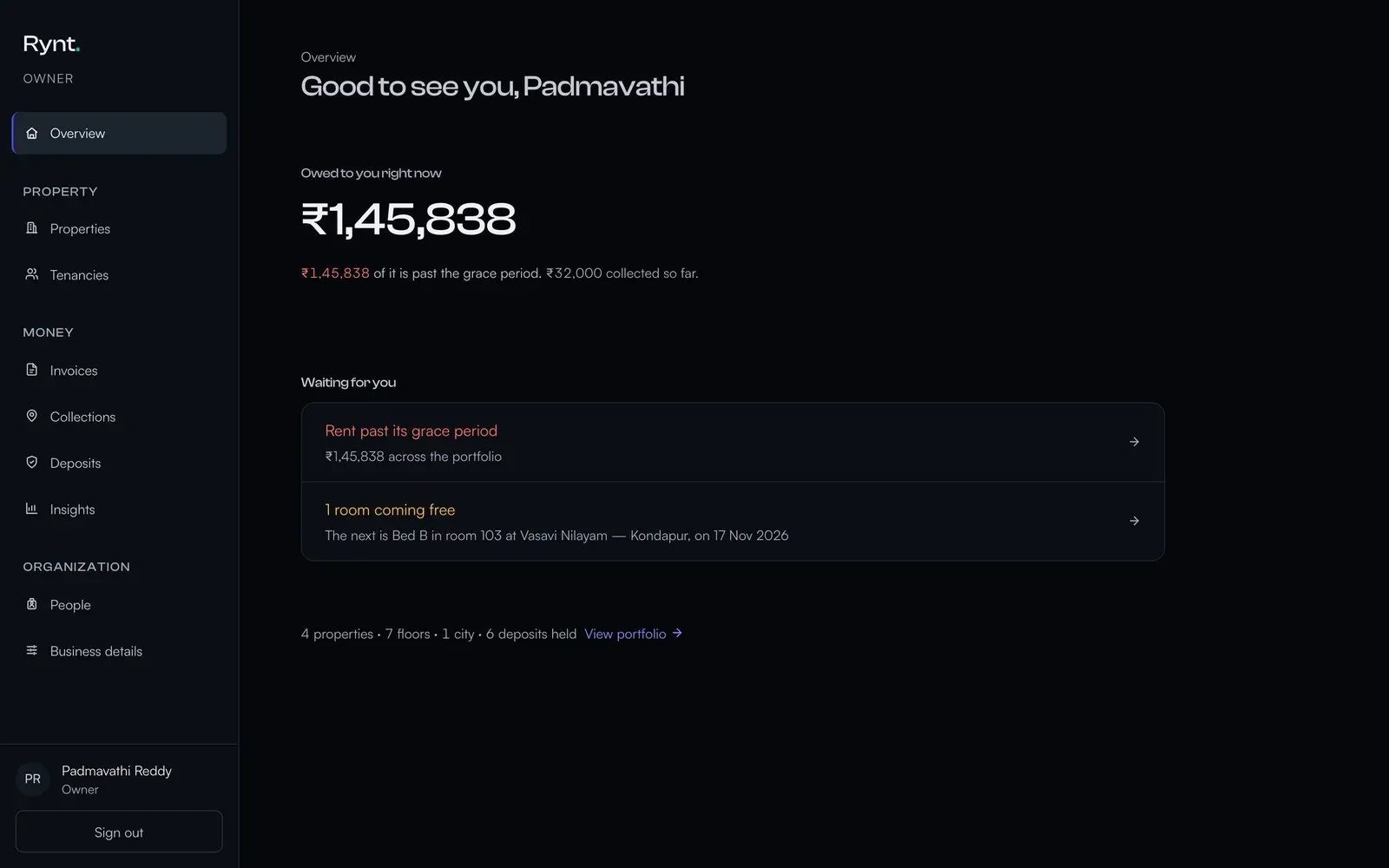
The owner portal’s first screen. Demo data, from the platform guide TrioFlare prepared for Rynt in October 2026.
The amount owed is the largest thing on the screen, because that is what an owner opens the app to check. Red means a payment was due and didn’t come; amber means something is still in progress.
Built for how rent works in India
- Every kind of rental. A flat, a PG or hostel rented by the bed, a building of flats, or flats in a society. Set-up asks only the questions that apply.
- Rupees written the Indian way, such as ₹1,45,838, with every due date in Indian time.
- PAN on every receipt, so tenants can claim house-rent allowance (HRA).
- Staff see only their part. Managers, caretakers and door-to-door collectors each get a shorter menu, limited to the buildings they work in.
- The owner sets the terms. Rent, deposit and any late fee are up to the owner. A rent change is saved with its date, so an old bill always shows what it showed on the day.
Cash at the door, with proof
A lot of rent in India is still paid in cash. In Rynt, the office starts a handover, the tenant gets a PIN that lasts five minutes, and they read it out to the collector. The collector can’t start it themselves, so the PIN is proof that the tenant was there and agreed the amount.
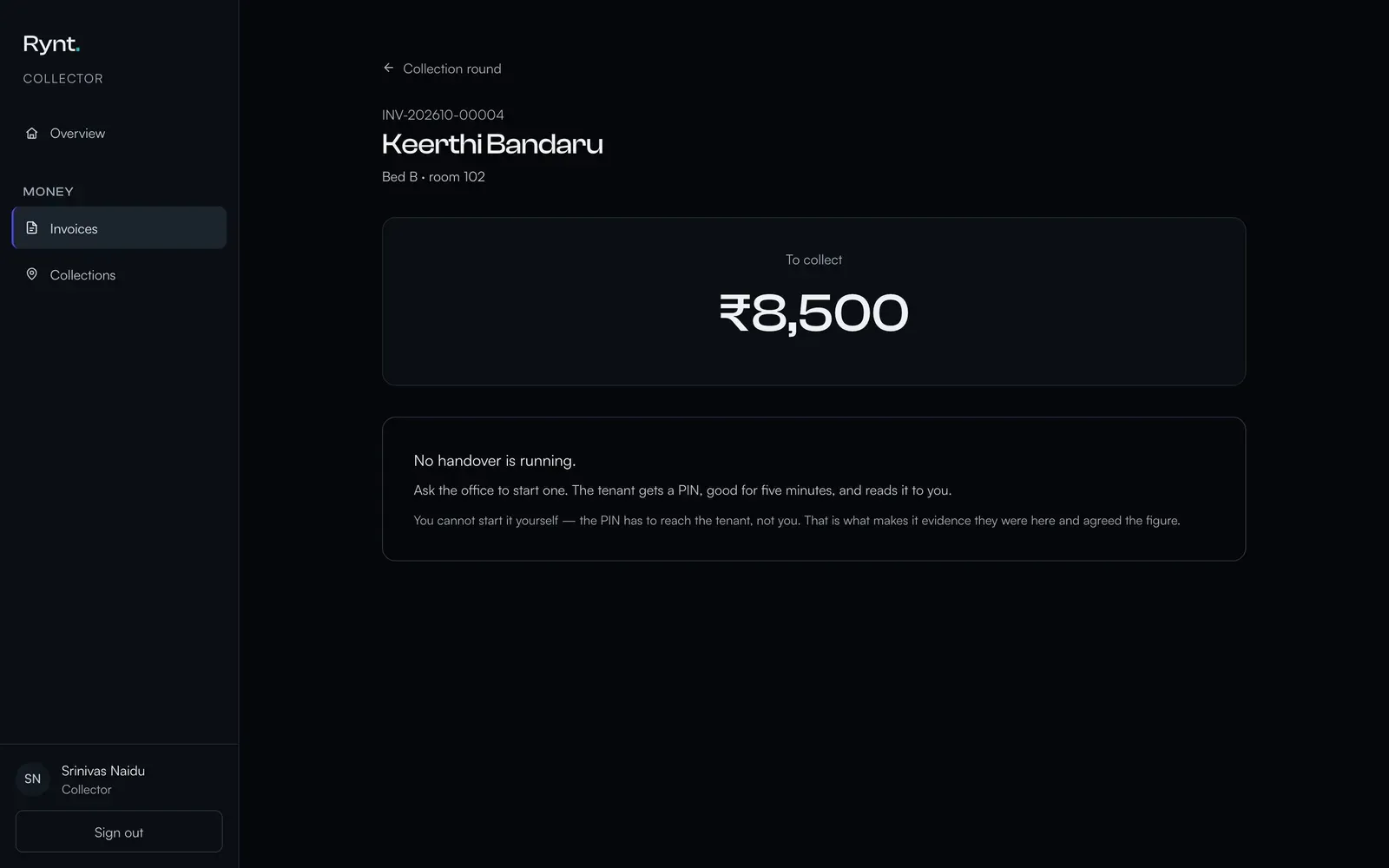
A collector’s view of one bill. Demo data, from the platform guide TrioFlare prepared for Rynt in October 2026.
What tenants see
Tenants don’t need to download anything. They open the tenant portal on their phone and see whether they are paid up, their rent, the deposit held for them and where they live. Former tenants keep access for 12 months to collect their receipts.
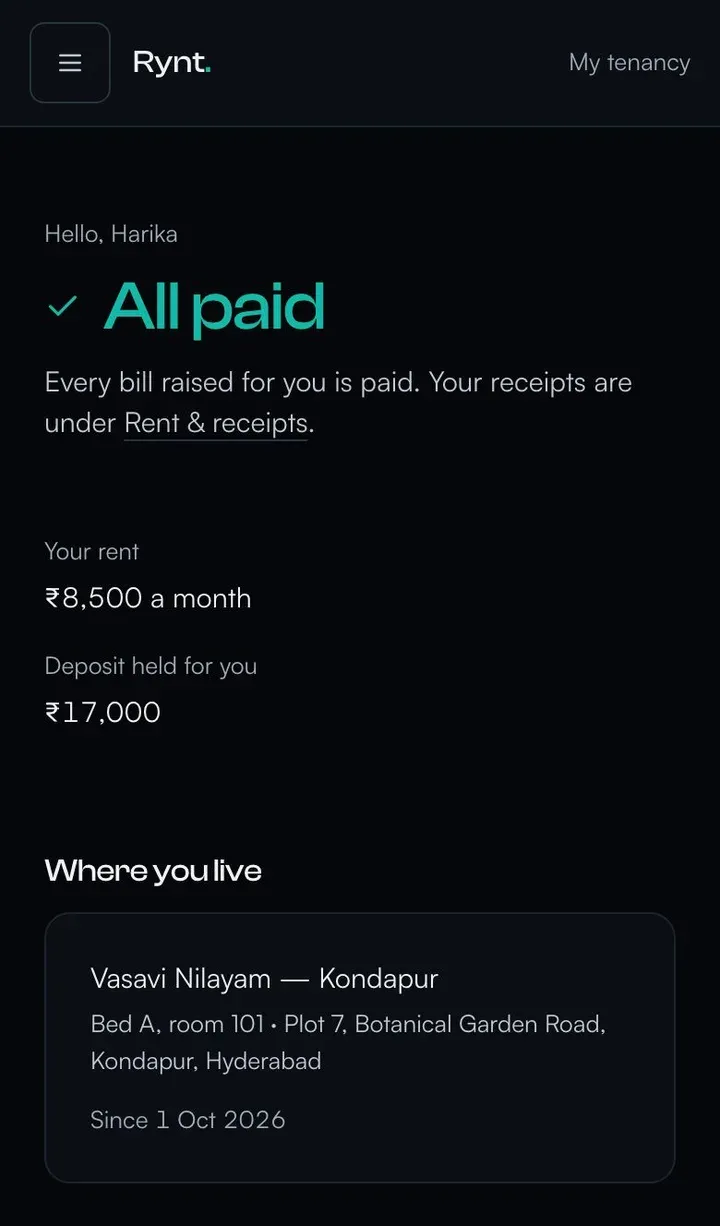
The tenant portal on a phone. Demo data, from the platform guide TrioFlare prepared for Rynt in October 2026.
Money and data kept safe
The platform follows a few rules that never bend:
- Every rupee is accounted for. Money records are never edited or deleted. A mistake is fixed with a new, correcting entry.
- A payment is saved only once, even if the button is pressed twice or the signal drops.
- Rynt never holds the rent. Reserve Bank of India rules don’t allow it, so online payments will go straight to each owner.
- Everyone sees only their own part, and this is enforced deep inside the system, not just on screen.
- Everything is on record. Every administrator action, sign-in and refusal is kept in a log that nobody can edit.
Testing was part of the work from the start. On 22 October 2026 the platform had more than 4,800 automatic tests, including tests that click through the portals in a real browser on a computer and a phone, and more than 60 database safety checks.
The work behind the screens
The portals are built with Next.js, on an API built with NestJS. Data lives in PostgreSQL, managed with Prisma, with Redis for background jobs such as the monthly bill run. The public website at ryntpay.com is built with Astro.
TrioFlare also wrote the platform guide for the client: a plain-English record of what each portal does, who can do what and what comes next, reissued as the work grows. Next on the roadmap are passkey sign-in, online rent payment, and one mobile app for owners and tenants.