SEO & GrowthVisual guide
What does AI tell people about your business?
By TrioFlare teamPublished Reviewed 4 min read
Select an image to open a larger version.
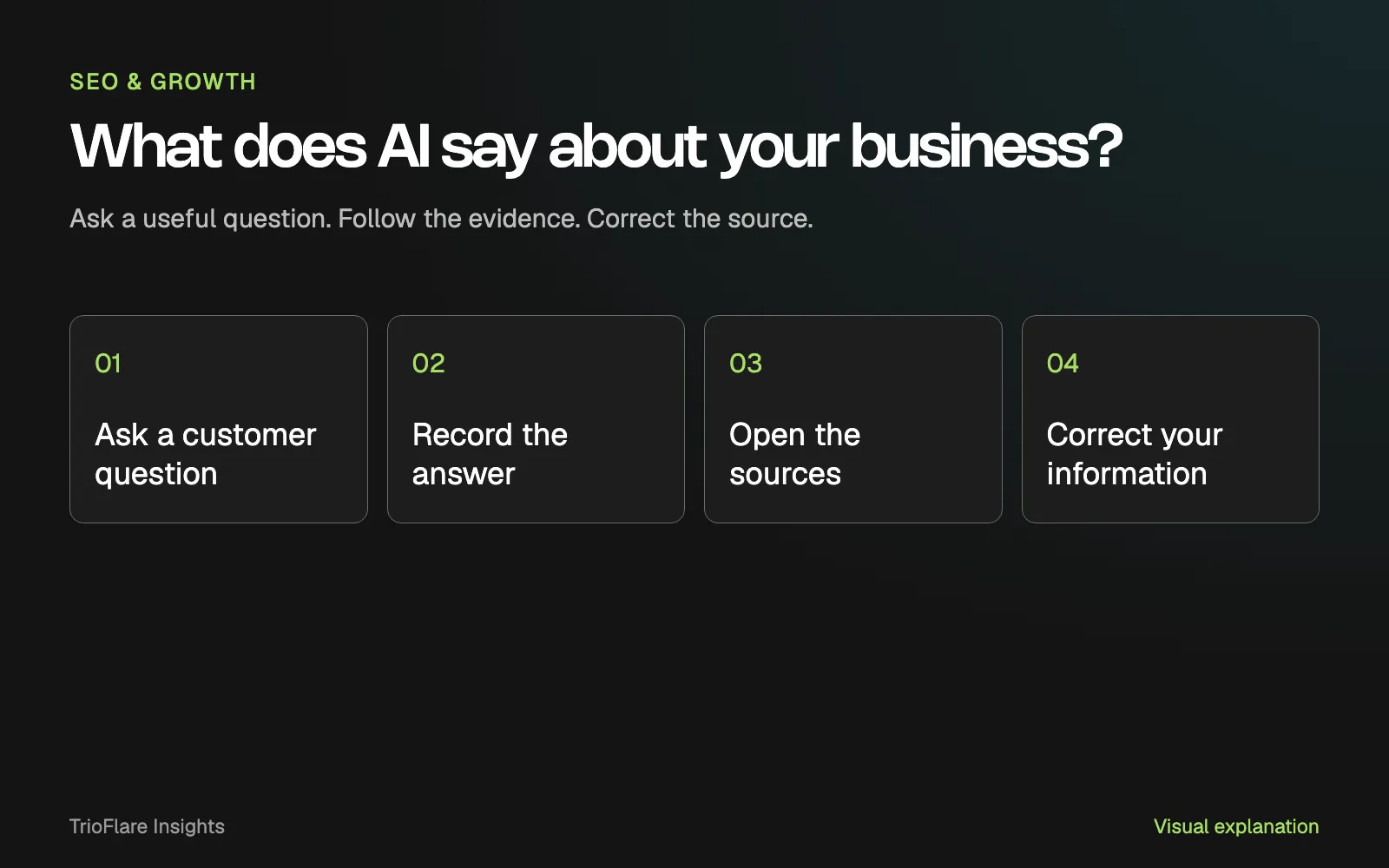
Ask an AI tool a question a customer might ask about your business, then follow the sources behind its answer. Check the details that could change someone’s decision: what you offer, where you work, how to book and how to contact you.
The useful result is a list of things to clarify or correct. You are trying to understand what a customer could see and whether the information helps them take the next step.
Keep your first check small. One service, one location and a few genuine questions are enough to begin a useful review.
Ask a question with a real decision behind it
Start with a question you have heard from a customer. You might ask whether a business serves a particular area, offers a specific service or accepts a certain kind of booking.
For example: “Does this business build websites for small retailers, and how do I ask for a quote?” This is a sample question. Replace the service and audience with the facts of the business you are reviewing.
Include the business name and relevant location when that is part of the customer’s question. Avoid treating a vague request such as “best company” as a precise test of your business information.
Use the same wording when you repeat a check. If you keep changing the question, it becomes harder to tell what changed in the answer.
Keep the answer and its context together
Record the exact question, tool, date and answer. If the tool shows sources, keep those links. Note whether you were signed in and whether the location or other context was part of the question.
Treat the result as an observation from that visit. Do not turn one answer into a claim that your business holds a permanent position. Google’s AI-search documentation explains that its AI features can use different techniques and produce different sets of responses and supporting links.
You can repeat the exercise with another tool, but compare the meaning and source quality before counting mentions. An answer that names your business while getting its service wrong needs attention.
Keep your notes factual. Write “this answer linked our old service page” rather than “AI does not like our business”. The first observation gives you something to investigate.
Check the details that could mislead a customer
Open the linked pages and read them as a new customer. Can you find the detail the answer relies on? Is it still correct? Does another page on your own site say something different?
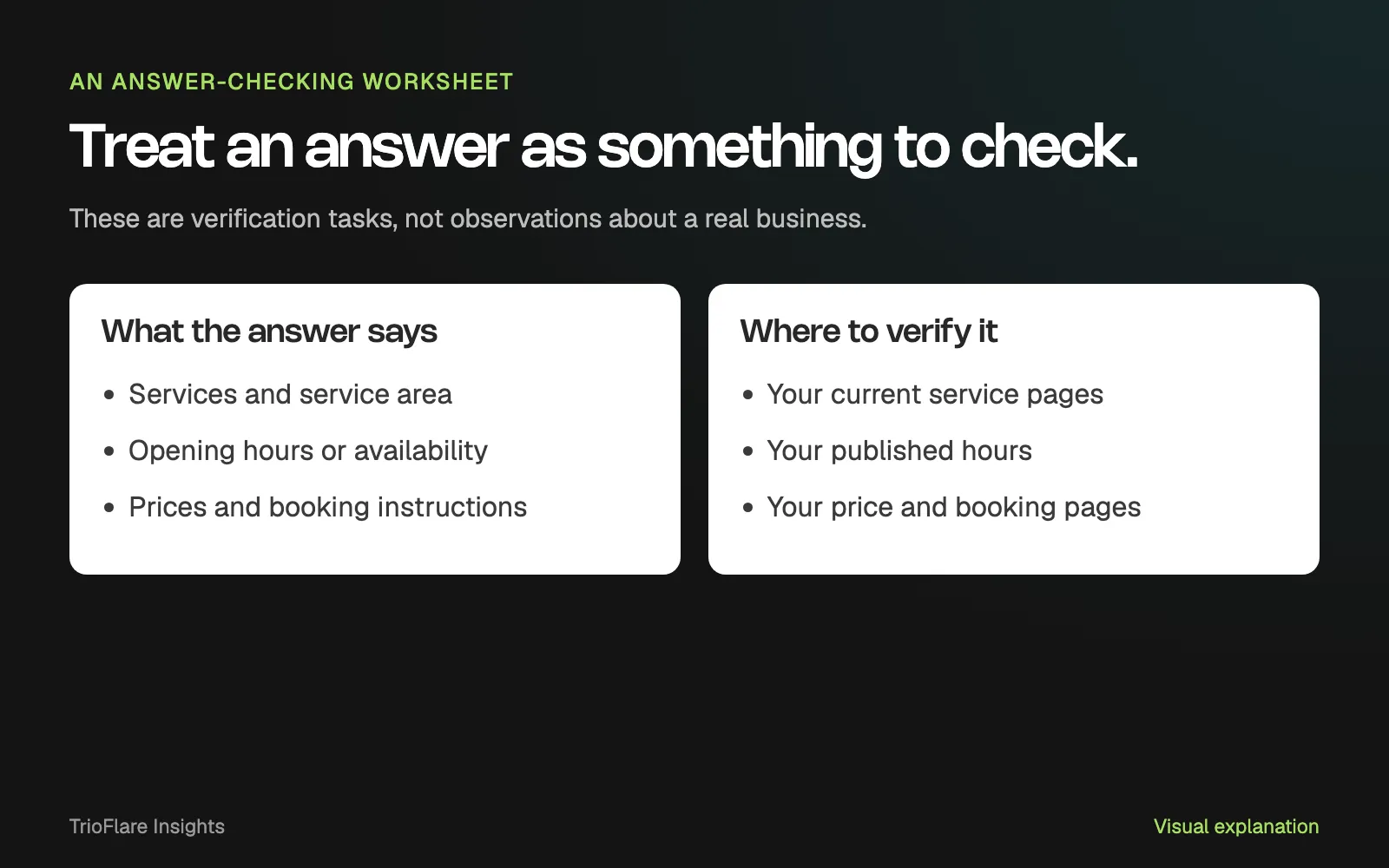
An editorial worksheet. The claims listed are questions to verify, not results from a live business audit.
Check the business name, contact route and service area first. Then check the information specific to the decision: a booking condition, a service exclusion or an outdated description of what the team does.
| Detail to review | Your note |
|---|---|
| What the business offers | Link the current service or product page |
| Where it works | Identify the page that explains the service area |
| Availability or opening hours | Check the published information at its source |
| Price or quote process | Confirm what is stated and what still needs a quote |
| Next action | Try the booking, enquiry or contact route |
Leave a blank when you cannot verify something. An unknown is useful information; filling it with a guess makes the worksheet less trustworthy.
Fix the source information you control
If a service page is unclear, improve it for the person reading it. Put the actual service, intended customer and next step in ordinary language. Explain important boundaries beside the offer they qualify.
Remove contradictions between pages. An old footer email, a forgotten contact page or a service description copied from an earlier version can make the business harder to understand.
Google says there are no special additional requirements for appearing in its AI Overviews or AI Mode. It points site owners to established search practices, including accessible text, useful content and structured data that matches the page. Apply the current guidance before buying an unexplained AI-visibility package.
If you add a diagram or screenshot, keep the essential explanation in text too. The visitor should not need to decipher an image to find your contact details or understand the service.
Follow the answer through to your website
An accurate mention is only part of the journey. Open the linked page on a phone and look for the next action. Can someone tell what happens after they send an enquiry or book a call?
Try that action yourself. A useful service page can still lose a customer at an unclear form or a broken booking handover. Keep those observations with the information audit so the review leads to practical work.
Repeat your original questions after making and checking the changes. Record what you observe, including an unchanged answer. Correcting your own pages is worthwhile even when an external tool has not reflected the change yet.
Use the checklist below to organise the work. If you need help with the source pages and the customer journey, our SEO service covers the site foundations as well as useful content.
Try this on your own project
Checks reset when you reload this page.
Key takeaways
- A polished answer still needs a source check.
- Clear, current business information helps people make a decision.
- A single AI response is an observation, not a stable ranking report.